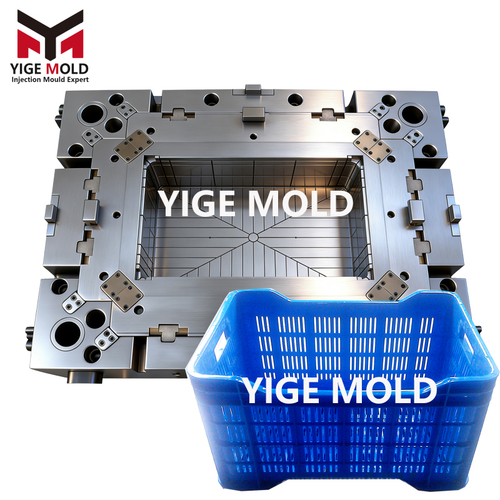
Introduction to Plastic Crate Molds
Plastic crate molds are indispensable basic process equipment in modern logistics, warehousing, and industrial production. As the core tooling for producing various plastic logistics boxes, storage containers, and turnover crates, their design and manufacturing standards directly determine the physical performance, service life, and economic efficiency of the final products. The following provides a comprehensive professional overview of plastic crate molds from multiple dimensions, including product overview, material characteristics, mold structure design, manufacturing processes, and quality control.
I. Overview of Plastic Crates and Their Molds
Plastic crates are logistics equipment products widely used in fields such as electronic auto parts, food and medicine, machinery and hardware, and postal express services. Unlike disposable plastic packaging, turnover crates require extremely high impact strength and aging resistance to allow for repeated use during long-term circulation, stacking, and transportation. To adapt to modern logistics' pursuit of maximizing space utilization, in addition to conventional standard and斜插式 (tilt-insert) crates, the mold design for collapsible crates has also become a major technical hotspot in the industry.
Plastic crate molds are precision industrial "mother machines" that transform plastic raw materials into solid crates through the injection molding process. An excellent mold must not only ensure precise dimensions and a smooth appearance of the crate but also balance high-efficiency production cycles with an extremely low defect rate.
II. Common Raw Materials and Their Impact on Mold Design
The raw materials for plastic crates are mainly HDPE (High-Density Polyethylene) and PP (Polypropylene), both of which possess high impact strength. These two materials have distinct physical pros and cons, directly influencing the shrinkage rate settings and cooling system layout in mold design.
Crates made from HDPE have good surface gloss, strong flexibility, and excellent impact resistance, making them highly suitable for heavy loads and high-level stacking. However, their drawback is a tendency to deform after molding, along with relatively weaker cold and heat resistance. Therefore, when designing molds for HDPE, engineers must fully consider its significant molding shrinkage rate and strengthen the setting and cooling designs in the mold structure to prevent warping after the product is ejected.
PP material offers excellent dimensional stability and is not prone to deformation, with superior cold and heat resistance. However, crates made from PP usually lack gloss and have slightly insufficient hardness during long-term heavy-load stacking, often requiring the mold design to incorporate thickened ribs for compensation. When designing the mold, engineers need to accurately calculate the dimensions of the cavity and core based on the material properties selected by the client, reserving reasonable shrinkage allowances.
III. Core Mold Structure Design
Plastic crates are typically large in size, and the walls often feature reinforcing ribs, latches, or hollow holes, posing a significant challenge to the mold's ejection structure.
Parting Surface and Gating System Design
To ensure the molding quality of the crate and facilitate ejection, the parting surface is usually selected at the maximum outline of the part's top flat surface. For large and deep crate parts, molds often adopt a large sprue direct gate design, placing the gate directly at the bottom of the part. This design allows the melt to enter the cavity with the shortest flow path, minimal flow resistance, and fast injection speed, while providing strong holding pressure and shrinkage compensation, effectively reducing sink marks on the product. To facilitate subsequent processing and maintenance, the cavity and core sections of large crate molds are often split into insert structures.
Complex Ejection and Side-Action Mechanisms
The evenly distributed reinforcing ribs and regularly arranged holes on all four sides of the crate create undercuts, making it impossible for the product to be ejected directly. Conventional mold designs often use lifter or slider side-core pulling mechanisms. However, for huge turnover crates, adopting a conventional slider design would result in an extremely large overall mold size, significantly increasing manufacturing costs and processing cycles.
Addressing this pain point, modern advanced mold designs break conventional thinking. For instance, they utilize hydraulic cylinder ejection combined with four-sided slider side-core pulling, and innovatively design a fixed-mold pull-rod and pull-plate structure. By using the opening stroke distance of the injection molding machine, the pull-rods and plates pull out the product to achieve secondary ejection. This design eliminates the traditional mold base feet and ejector plate sections, greatly streamlining and reducing the overall mold size. This not only lowers mold costs but also effectively prevents quality defects such as stress whitening, cracking, or warping caused by forced ejection.
IV. Manufacturing Process and Quality Control
A high-quality plastic crate mold relies on precision processing equipment and rigorous manufacturing processes.
In the processing stage, mold manufacturing typically employs high-precision CNC (Computer Numerical Control) machines and EDM (Electrical Discharge Machining) to ensure the fitting accuracy of cavities, cores, and various sliders and inserts. The mold steel must undergo strict heat treatment to improve its wear and corrosion resistance, thereby extending the mold's service life.
Regarding quality control, the uniform layout of cooling channels is crucial. A reasonable cooling system ensures uniform internal and external cooling of the plastic part during the molding process and consistent density distribution, thereby significantly reducing post-molding shrinkage and deformation. Additionally, the mold's venting design must be rational to prevent appearance defects such as trapped air and burning during high-speed injection.
V. Conclusion and Outlook
The plastic crate mold industry is developing towards high performance, multi-functionality, and environmental adaptability. With the rapid upgrade of the logistics industry, the market demands higher load-bearing capacity, lightweight design, and collapsible storage functions for crates. This not only requires mold enterprises to continuously innovate in design (such as applying hot runner technology to reduce trimming costs of sprue materials and adopting secondary ejection mechanisms to solve complex undercuts) but also demands the introduction of advanced CNC equipment and a comprehensive quality management system in production and manufacturing.


